Something extraordinary has already happened inside your organisation. An employee has delegated work to something that isn’t human. They may have:
Asked ChatGPT to research a subject.
Asked Copilot to analyse a document.
Asked Claude to challenge an idea.
Or created an AI agent to complete a series of tasks on their behalf.
The work has been delegated. The AI has responded. And the manager may not even know it happened. This is why I believe we are the last generation of leaders who will manage only humans.
The next generation of managers—and quite possibly the current one—will manage people, AI systems, automated workflows and agents operating inside other systems.
That is a huge shift. Not simply in technology. But in leadership.
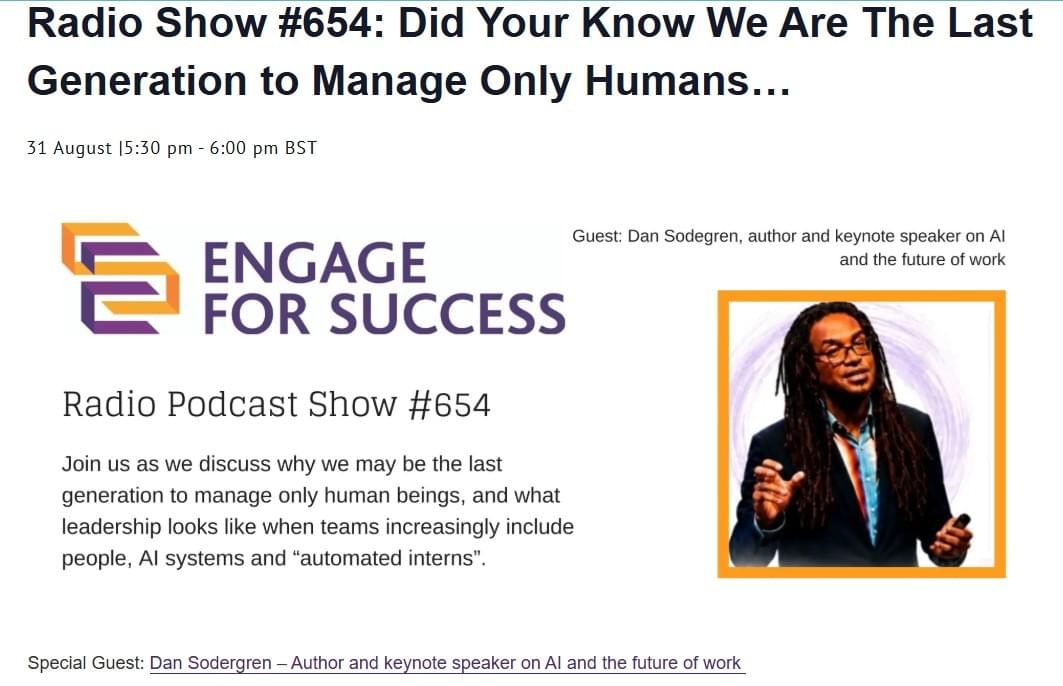
On Monday 31 August at 5:30pm BST, I’ll be joining Jo Dodds on the Engage for Success Radio Podcast to discuss exactly this.
The conversation is called:
And while the technology is fascinating, the real conversation is about people.
Because AI is not mainly a technology project.
It is a leadership, management and employee-engagement project.
AI Adoption Is Broad. But Still Shallow
The latest evidence tells an interesting story.
According to the Office for National Statistics, AI adoption among UK businesses with ten or more employees has risen from approximately 12% in late 2023 to approximately 35% in 2026.
That sounds like extraordinary progress. But those businesses are still using only 1.6 different AI technologies on average.
Broad adoption.
But shallow adoption.
AI has entered the building. But it has not yet transformed how most work gets done.
Google’s enormous AI and Economy ATLAS study found a remarkably similar pattern.
Based on 15 million anonymised interactions with Google’s AI products, AI use appeared across 68% of occupations representing around 90% of US employment.
But within a typical job, it touched only about 21% of tasks.
Again… Broad. But shallow. People have access to AI. They are experimenting with AI.
But most organisations have not redesigned their workflows, management systems or cultures around it.
And that is where the real work begins.
Your AI Systems Are Automated Interns
I have called AI systems “automated interns” for years. Because that is the most useful way I have found to describe them. An automated intern can be incredibly fast.
It can research, draft, summarise, analyse, organise and generate ideas.
It can work at any time.
It doesn’t get bored.
And it can process more information than any human being reasonably could.
But it still needs managing.
You would not give a new intern a vague instruction, no context, no training and no supervision—and then send their first piece of work directly to your most important client.
Well…
You shouldn’t.
Yet that is exactly what some organisations are doing with AI.
They buy the technology.
Give people access.
And hope something productive happens.
An automated intern needs:
- A clear brief.
- The right context.
- Relevant information.
- Defined boundaries.
- Regular checking.
- Constructive feedback.
- Human accountability.
The better you manage it, the better it becomes.
The worse you manage it, the more confidently it can create something completely wrong. This is why managing AI is becoming a genuine leadership skill.
It is not merely “prompt engineering”.
It is the ability to decide:
- What should humans do?
- What should AI do?
- What should humans and AI do together?
- Who remains responsible for the final decision?
That allocation of work will become one of the defining management capabilities of the next decade.
AI Leadership Is Really an Employee-Engagement Challenge
Most leaders are still asking questions such as:
“What AI tools should we buy?”
“How much will they save?”
“Which jobs can we automate?”
Those questions matter.
But they are not the first questions.
The first questions should be:
“Do our people understand why we are introducing AI?”
“Do they trust what we are telling them?”
“Do they believe they have a place in the organisation’s future?”
“Have we given managers enough time and training to lead this change?”
Because you cannot prompt your way out of a trust problem.
According to Personio’s Workforce Pulse research, only 36% of employees believe their employer provides adequate AI training or support.
Meanwhile, 44% want more help. That gap matters.
Employees are experimenting.
Technology is moving.
But organisational support is struggling to keep pace.
This creates shadow AI.
People quietly using tools without telling managers.
Work being processed through systems that may not be approved.
Sensitive information being shared without people understanding the risk.
And knowledge being concentrated among the small group of employees curious enough to work everything out for themselves.
That is not simply a technology failure.
It is an engagement failure.
Managers Will Decide Whether AI Transformation Works
The evidence about managers is even more powerful.
Microsoft’s 2026 Work Trend Index found that when managers actively modelled AI use, employees reported:
- A 17-point increase in the value they experienced from AI.
- A 22-point increase in critical thinking about AI use.
- A 30-point increase in trust in agentic AI.
When managers created psychological safety around experimentation, employees reported up to 20 points higher AI readiness and value.
In other words, managers cannot simply announce an AI transformation.
They have to demonstrate it.
They have to create a safe environment in which people can experiment, make mistakes, challenge outputs and admit when they do not know something.
Leaders do not build trust by pretending they have every answer.
They build trust by showing people how to find better ones.
This is why my work as an AI and future-of-work keynote speaker concentrates as much on human psychology as it does on technology.
The successful organisations will not simply have the most advanced AI.
They will have managers capable of helping people use it well.

The Four Intelligences Leaders Now Need
This is the central argument behind The Fifth Industrial Revolution.
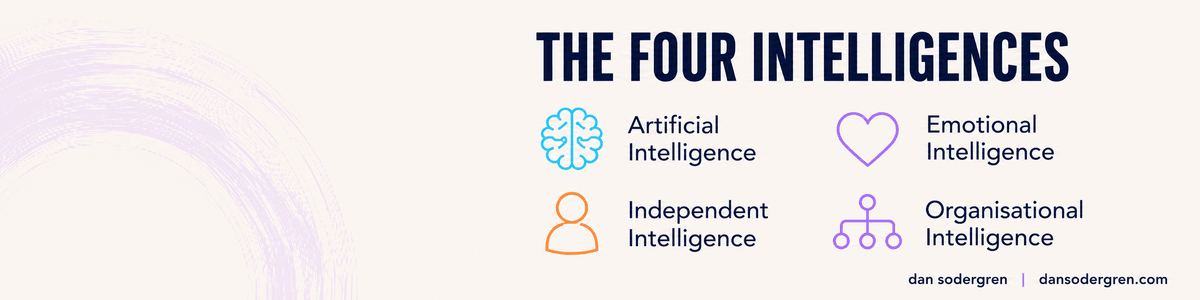
I believe people and organisations now need four different types of intelligence.
1. Artificial Intelligence
Artificial Intelligence gives us speed, scale, processing power and support.
It allows us to build our automated interns.
But access to AI is not enough.
People must know how to brief it, question it, check it and apply it.
2. Emotional Intelligence
Emotional Intelligence helps us understand fear, resistance, motivation and trust.
It allows leaders to have honest conversations about jobs, productivity and change.
Because telling frightened employees to “embrace AI” is not a change-management strategy.
3. Independent Intelligence
Independent Intelligence is our ability to think critically.
To question the first answer.
To recognise bias.
To challenge AI output.
And sometimes to challenge leadership decisions too.
The more powerful our machines become, the more important independent human judgement becomes.
4. Organisational Intelligence
Organisational Intelligence is knowing how to turn an idea into meaningful change.
It means understanding your culture, systems, politics, incentives, blockers and informal networks.
An AI pilot can work brilliantly in isolation and still fail completely when introduced into the real organisation.
Because organisations are not machines.
They are human systems.
How the Four Intelligences Connect With Employee Engagement
This is what makes my conversation with Jo and Engage for Success particularly interesting.
Engage for Success’s Four Enablers describe the organisational conditions needed for people to perform at their best.
My Four Intelligences describe the human and organisational capabilities needed to create those conditions in the age of AI.
They connect naturally.
Strategic Narrative Requires Organisational Intelligence
Leaders must explain why AI is being introduced, where it can create value and how work may change.
If leaders leave a gap, employees will fill it with their own story.
And that story may be:
“They are training the technology to replace us.”
Engaging Managers Need Artificial and Emotional Intelligence
Managers must understand what AI can do.
But they must also understand how their people feel about it.
They need to manage machines without forgetting how to lead humans.
Employee Voice Requires Independent Intelligence
Employees need permission to question, test and help design new workflows.
The people closest to the work will often understand the best opportunities—and the greatest risks—better than senior leadership.
Organisational Integrity Requires Emotional and Organisational Intelligence
Leaders must be honest about jobs, data, productivity, accountability and trade-offs.
If an organisation says AI is only being introduced to help people while secretly planning headcount reductions, employees will eventually discover the truth.
And once trust disappears, no technology platform can reinstall it.
Cut Headcount—or Retrain, Retain and Scale?
There is a strategic choice underneath all this.
Some organisations will use AI primarily to reduce costs and remove jobs.
Others will use it to make their existing people more capable.
Microsoft’s 2025 Work Trend Index captured this tension perfectly.
While 33% of leaders were considering headcount reductions, 78% were considering recruiting for new AI-related roles.
And 83% believed AI would allow employees to take on more complex and strategic work earlier in their careers.
The future is not automatically one of mass replacement.
It is a choice.
My preferred route is:
Retrain. Retain. Scale.
Train people to use AI properly.
Keep the experience, relationships and organisational knowledge they already possess.
Then use technology to make those people faster, more creative and more valuable.
That does not mean every job will remain unchanged.
It won’t.
But there is a profound difference between redesigning work with people and imposing technology upon them.
One builds capability.
The other builds fear.
The Future Is Not Humans Versus AI
We are entering one of the most important management transitions in modern history.
Leaders will increasingly manage mixed workforces.
Humans. AI assistants. Automated interns. AI agents.
And systems operating inside other systems.
But technology will not decide whether that future is better.
Leaders will. Managers will. Employees will.
The organisations that succeed will be the ones that combine the speed of Artificial Intelligence with the empathy of Emotional Intelligence, the judgement of Independent Intelligence and the practical understanding of Organisational Intelligence.
Because the future is not humans versus AI.
It is leaders who can manage humans and AI outperforming those who can only manage humans.
And that future has already begun.
Listen Live: The Last Generation to Manage Only Humans
Join Jo Dodds and me on the Engage for Success Radio Podcast on:
Monday 31 August 2026
5:30pm BST
We will explore AI, leadership, employee engagement, the Four Intelligences and what happens when the people you manage are no longer all people.

About Dan Sodergren
Dan Sodergren is an AI transformation strategist, author, technology expert and keynote speaker specialising in Artificial Intelligence, the future of work and the Fifth Industrial Revolution.
He helps organisations understand how technology, leadership and human behaviour must work together—and how leaders can prepare their people for what comes next.
Find out more about booking Dan as an AI keynote speaker, explore his radio and podcast work, or discover his approach to AI leadership training.