AI can help us do more than we ever imagined. It can make work faster, smarter and more creative. It can help us protect jobs, build new opportunities, reduce wasted time and give people more space to be human at work.
Handled well, AI could help us move towards a better future of work. Maybe even a three or four-day week. Maybe more meaningful work. Maybe bigger social impact.
But there is a problem.
A very human one.
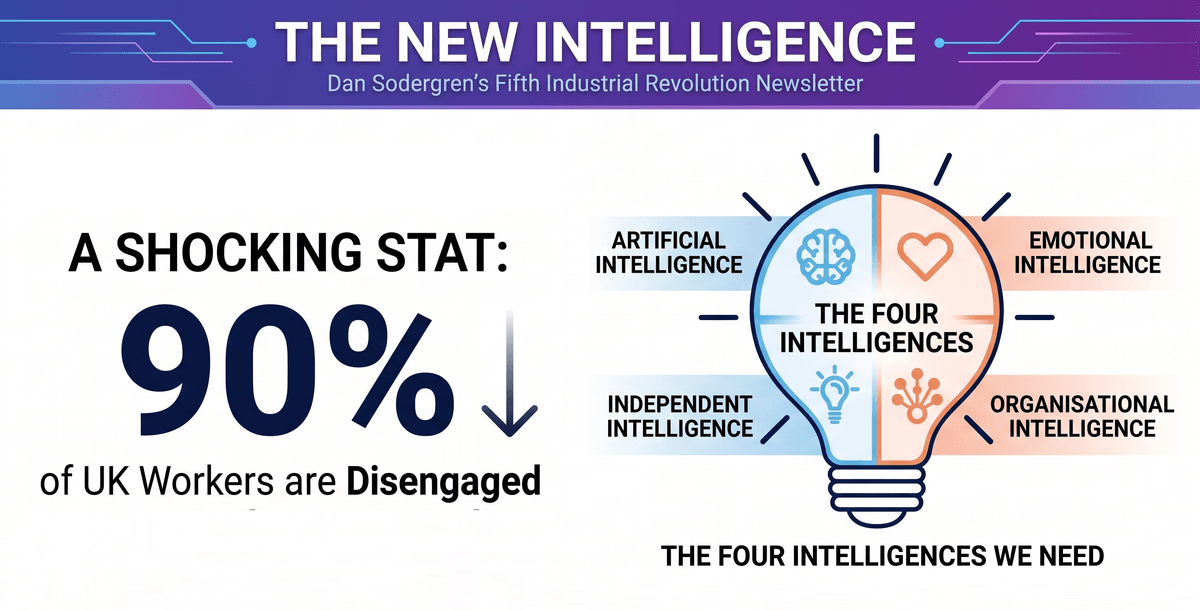
According to Gallup, only 10% of UK workers feel engaged at work.
Ten percent.
That means nine out of ten people in many organisations are not emotionally connected to what they do. They are present, but not truly there. They are logging in, turning up, attending meetings, answering messages and quietly counting the hours.
And this is before AI has really reshaped the workplace.
That should worry every leader.
Because the real risk is not simply that AI will replace people. The deeper risk is that AI will expose the people who have already checked out.
As a Future of Work Speaker, keynote speaker and AI expert, I see this in organisations all the time. The people who are curious, engaged and willing to learn are already using AI to do in hours what used to take days. They are experimenting. They are building. They are quietly becoming more valuable.
Now follow the maths.
If 10% of your workforce becomes dramatically more productive with AI, that small group starts to create the output of a much larger team. The gap between the engaged and disengaged does not just grow. It becomes impossible to ignore.
The danger is not that AI takes everyone’s job.
The danger is that your best people become independent, powerful and ready to leave.
This is not a technology problem.
It is a trust problem.
People do not hide AI tools from leaders they trust. Shadow AI is not just a policy failure. It is a cultural warning sign. It tells us people are working around the system because they do not believe the system is working for them.
That is why the conversation about AI has to move beyond tools, prompts and platforms.
We need to talk about leadership.
Gallup also found that 70% of team engagement is attributable to the manager. Not the strategy deck. Not the company values on the wall. Not the latest software rollout. The manager.
Yet managers themselves are struggling. Many are undertrained, overworked and expected to lead people through the biggest workplace revolution in generations while trying to understand tools they barely have time to use.
That is not fair. It is not sustainable. And it is not leadership.
This is why I keep saying, on every stage, in every boardroom and in every AI training session:
Human psychology is more important than AI technology.
This is the heart of The Fifth Industrial Revolution Keynote. The Fifth Industrial Revolution is not just about machines becoming more intelligent. It is about humans becoming more conscious, more capable and more connected.
To navigate this shift, people need four kinds of intelligence.
Artificial Intelligence gives us speed, scale and support. I often call it the automated intern. It can save time, but saved time means nothing if people do not care enough to use it well.
Emotional Intelligence is what keeps people connected. It is the ability to listen, lead, empathise and have difficult conversations without losing humanity.
Independent Intelligence is the courage to think for yourself. To question the first answer. To challenge weak AI output and weak leadership decisions.
Organisational Intelligence is knowing how things really get done inside a business. The politics, the systems, the culture, the blockers and the opportunities.
This is why you cannot prompt your way out of a culture problem.
Buying more AI tools will not fix disengagement. More licences will not create trust. Another innovation workshop will not save a workforce that feels ignored, exhausted or replaceable.
The organisations that win the next decade will not simply be the ones with the best AI stack.
They will be the ones where people actually want to show up.
So here is the real challenge for leaders.
Stop buying tools before you buy time.
Time for managers to learn. Time for people to experiment safely. Time for honest conversations. Time to explain why AI matters, what it means, and how people can grow with it rather than fear it.
For employees, the question is equally important.
Have you checked out because you do not care?
Or because nobody gave you a reason to care?
That answer matters.
Because the future of work will not be built by technology alone. It will be built by people who feel trusted, trained and valued enough to use technology well.
That is the real opportunity of the Fifth Industrial Revolution.
Not better software.
Better humans, using better tools, inside better organisations.
That is people power.
And that is still the most important intelligence we have.
Dan Sodergren is a Future of Work Speaker, Technology Expert, AI thought leader, Tech Futurist Speaker and Fifth Industrial Revolution corporate speaker. For organisations looking for a future of work expert for hire, Dan delivers keynotes and AI training that help leaders understand technology, people and change.